
The Egyptian Museum of Turin
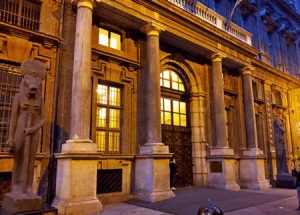
Located in the historic Palace of the Academy of Sciences, it is one of the most important of the entire planet (second only to Cairo) and the oldest in the world (founded in 1824).
Its interior, as it’s easy to deduce, is devoted entirely to Egyptian art and culture of ancient Egypt.
 The foundation of the Museum coincides with the acquisition by King Carlo Felice of over 5200 objects (mummies, statues, sarcophagi, papyrus for a symbolic sum of 4,000 lire) part of the remarkable collection of Bernardino Drovetti, Piedmontese, consul in Egypt.
The collection increased dramatically over time, so as to get around the 30s to about 30,000 pieces, thanks also to the activity at the end of ‘800 of the then director Ernesto Schiaparelli who led several campaigns of excavations in Egypt.
Currently, the Egyptian Museum of Turin has about 37,000 pieces, some priceless. Among these, must be mentioned in particular the Tomb of Kha and Merit (discovered just during one of the expeditions led by Schiaparelli), the Linen Cloth (datable between 4300 and 3700 BC), and above all one of the most important documents concerning the Egyptian civilization: the Royal Papyrus (1292-1186 BC), which contains the list of all the Kings from the foundation to the XVII New Kingdom Dynasty (about from 1620 to 1535 BC).
This sequence of Egyptian sovereigns reports accurately, in hieratic, succession, age, and years of reign.
 Impressive also the number of the statues, including some of great importance and value. The most famous is the diorite statue of King Ramses II (1279-1213 BC), from Thebes: authentic masterpiece, it is considered the most faithful portrait of the longest-lived Egyptian pharaoh of all time.
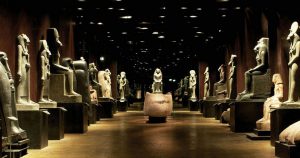
But it is necessary to stop a few minutes (even more, if you have the time) in the Statuary, where the monumental statues that portray the most important Pharaohs of ancient Egypt but also gods such as Ptah, Amun, Hathor and Sekhmet are preserved.
Not only: in the Statuary there are also items like coffins, offering tables and sphinxes.