
In Turin all roads lead to an elegant sobriety
An austere city, many define it cold, many others are of the opposite opinion.
Friedrich Nietzsche said of Turin that “here is worth living in all aspects” and indeed everyone, from the place he lives in, wants to find something of his own being.
The city of Turin.
 Turin (Torino in Italian, Turin in Piedmontese) has less than 1,000,000 inhabitants, while the metropolitan area has over 2.2 million inhabitants, is the largest in Italy and coincides geographically with the former province of Turin.
It is the third economic productive complex of the nation after Milan and Rome.
History of Turin.
Town founded around the third century BC by Taurini, Celtic-Ligurian population, then converted in Roman colony by Augustus with the name of Iulia Augusta Taurinorum in the first century BC.
During the Dark Ages it was the Duchy of Turin, in the eleventh century came under the control of the Savoy and since 1720 it was the capital of the Kingdom of Sardinia, until the Italian unification of which it was the first capital.
Turin today
Today is one of the major academic, artistic, tourist, cultural and scientific centers, and one of the most important Baroque cities of Europe.
Famous are its historic cafes, increased especially in the Risorgimento period and the Belle Époque.
This city was birthplace of the great writers and intellectuals such as Edmondo de Amicis, Emilio Salgari, Italo Calvino, Natalia Ginzburg, Norberto Bobbio, Cesare Pavese, Primo Levi, Umberto Eco.
The Symbols
Martini, the gianduja chocolate and espresso, are some of the symbols of made in Italy from Turin that, today as in the past, remains the fulcrum of Italian car industry.
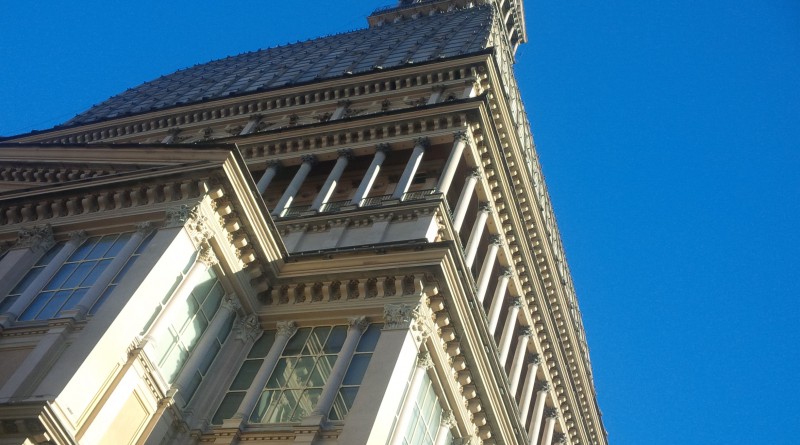
The Mole Antonelliana, impressive in dominating the city, offers spectacular views of the cliffs, and houses the national museum of cinema.
The straight and perpendicular streets, all rigorously tree-lined, deviate from the concentric logic of many Roman urban areas and the main streets of the city center are for most circumscribed by endless arcades.
Copious are the Savoy residences, World Heritage Sites of UNESCO, such as the hunting residence of Stupinigi, the castles of Valentino, Agliè, Racconigi, Rivoli and Moncalieri, the Villa della Regina and the realm of Venaria Reale.
The atmosphere in the city is light, both in the city center, meeting place of Turin people, and in the most refined neighborhoods along the Po river.
The attitude that is spotted in many cafès, restaurants, bars, is quite helpful and friendly.
From Carlo Alberto square to San Carlo square, contrary to what you might think of a northern city, Turin preserves many places that in a beautiful sunny day can make it a fine living.