
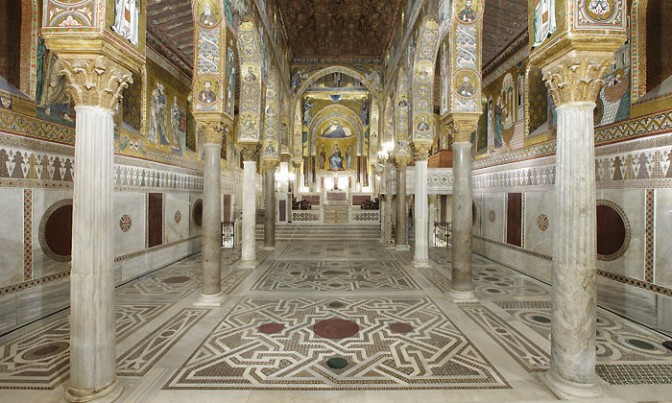
The beautiful Palatine Chapel
In Palermo, tourists can easily visit the beautiful Palatine Chapel. This basilica, dedicated to the Apostle Peter, consists of three naves and is located in the architectural complex of the Norman Palace. The exact location is Piazza Indipendenza, Palermo.
History
King Ruggerp II wanted to build it as a private church of the royal family. The construction of the Palatine Chapel started in 1130, then it was consecrated on 28th April 1140, while the work was completed only in 1143.
On the exterior of the chapel there is an inscription in Greek-Byzantine, Latin and Arabic commemorating the construction of a horologium in 1142.
During the earthquake occurred in 2002 the Palatine Chapel was damaged, so works of restoration were necessary and ended in July 2008. The project of restoration was drawn up by the architect Guido Meli, the manager of the “Regional Centre for restoration “of the Sicilian Region.
The wonderful Palatine Chapel, from 3rd July 2015, finally came to be part of the World Heritage (UNESCO) as part of the ”Arab-Norman Route of Palermo, Cefalu and Monreale”, considering its importance from a cultural and historical point of view.
Structure
The eyes of the visitors glimpse, once in the basilica, the three naves separated by columns made of granite and marble in composite capitals that support the structure of pointed arches. Then the dome which is raised above the three apses of the sanctuary. After later constructions, it was no longer possible to see from the outside the dome and the bell tower, because they were incorporated into the Royal Palace.
Both the dome, the transept and apses, are totally covered at the top with magnificent Byzantine mosaics, which are among the most significant of all Sicily.
There are depicted Pantocratore blessing Christ and the angels around (depicting Psalm 11.4), which result one of the largest impact images, then there are the evangelists and various other biblical scenes. The oldest mosaics are those that decorate the dome.
If we look at the wooden ceiling of the central nave and also the trusses of the other two naves, it can be seen that they are decorated with paintings and carvings in Arabic style, the muqarnas. And there are represented stars with animals, paradise as described by the Quran, life scenes of Islamic court and dancers.