
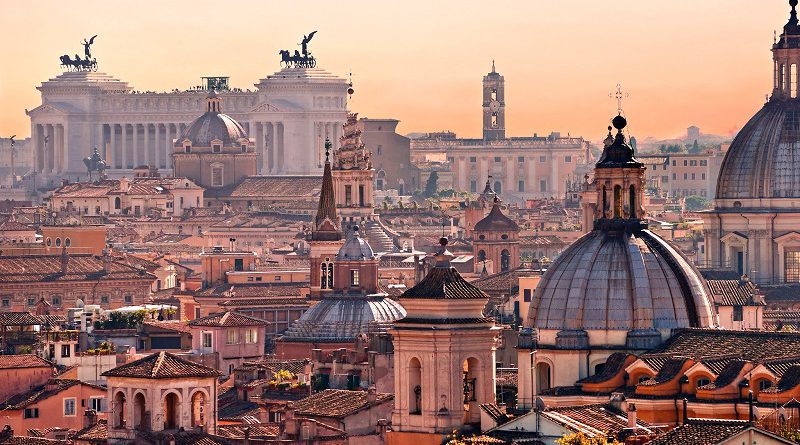
Rome “alternative” itinerary
Short “alternative” tourist itinerary: curiosities and legends – enriched with “Roman polemic”.
The novelty of the itinerary that I propose to you is that you enter a church or a palace from the main entrance, and exit a secondary door.
You will see, the effect is certainly curious.
 Departure from Piazza Venezia > via del Corso > 2nd street on the left (via del Caravita) > arrival in Piazza S. Ignazio di Loyola
Here you can admire (cars parked permitting), one of the first squares built in the 18th century in a “barocchetto” style, designed by the architect Filippo Raguzzini. There are also buildings positioned as theatrical wings.
Then you can see the baroque church, connected to the building of the Roman College.
The church started in 1622 but in 1685 it is still dome-free due to the depletion of funds.
Andrea Pozzo draws it on a 17-meter-diameter canvas, and seen from a yellow circle placed on the floor, in the center of the nave, it is practically impossible to distinguish it from a real one.
Continuing towards the apse, the non-expert person may feel slightly dizzy, seeing the dome “move and tilt”.
The canvas of the false dome was torn open in 1891.
There was an explosion of the Monteverde powder magazine. The canvas was restored in the 1960s.
In the twenties of the 1900s, there was also a project to build a real dome, which remained in its intended state.
The vault of the nave is the masterpiece of Father Andrea Pozzo, one of the last great scholars of perspective. It shows the Glory of St. Ignatius (c. 1685).
To illuminate the dome, the usual coin comes in useful; you’d better not use it. If the dome is illuminated, the trick can be unveiled.
You’d better wait for the usual Japanese tourist who will put a euro for you.
Once you go out of the church (paying attention to the speeding motorbikes), go left into via del Seminario (continuation of via del Caravita), and you will get to via della Minerva.
From here, you have the alternative to turn left up to the Church of Minerva, or right up to Piazza della Rotonda.
If you have opted for the Church of Minerva, on the square you can admire the “Pulcino della Minerva”, the elephant that supports the obelisk, about 5 meters high, and found back again (the obelisk, not the elephant).
In the gardens of the Dominican convent in 1665
The project of the elephant was created by Bernini – “… a strong mind is necessary to support a solid wisdom”, says the inscription on one of the sides of the statue.
Bernini was inspired by the “battle of love in Polifilo’s dream” by Francesco Colonna, a fifteenth-century novel very well known in those days.
In the novel, full with symbolic references, Polifilo meets a stone elephant carrying an obelisk.
Father Paglia objected, according to the classical canons, that “no perpendicular weight should have been placed on the void because it would not have been solid or durable”.
So it would have been necessary to insert a stone cube under the elephant’s belly.
Bernini tried to oppose this change, having already realised other works in which heavy elements weighed on empty spaces (the famous Fountain of the Rivers in Piazza Navona), but it was decided that support was to be added.
For this reason, after it was placed right in the middle of the square, people began to call it Porcino Della Minerva.
The name changed later to “pulcino” (chick), perhaps for a simple phonetic reason.
But Bernini spotted a vengeance: in the final version, which was later realised by his pupil Ercole Ferrata in 1667, he drew the elephant to point his bottom towards the Dominican convent, with its tail slightly moving, as if to greet Father Paglia and the other Dominicans.
Now enter the church of “Santa Maria Sopra Minerva”, so called because it was built on the temple of Minerva. It is known as the only Gothic church in Rome.
The current building was built starting from 1280, on a project, of Fra Sisto and Fra Ristoro (the latter probably inventor of fast food).
The same who built S. Maria Novella in Florence – at the end of the century it was already accessible for worship.
But the works went on throughout the Fourteenth century, slowing down due to the absence of the Papal court which had already moved to Avignon.
Until 1453 the present façade was built. It was built temporarily.
Up to the Nineteenth century, nothing would drastically change.
In the seventeenth century the interiors will undergo several changes in Baroque style. Between 1848 and 1855 the father Girolamo Bianchedi will perform a rather unhappy restoration of the original Gothic lines.
The simple, shell-like façade, similar to that of the Aracoeli, has three portals, of which the central one is remarkable.
An immense convent complex is annexed to the church, which in the past also housed the ecclesia court of the Inquisition ecclesiastical, belonging to the Dominican order, and in which the condemnation of Galileo was pronounced.
After 1870, expropriated, it became the seat of the Ministry of Education, then of the Post Office. Today it is home to the offices of the Chamber of Deputies, including the parliamentary commissions and the library, which can be accessed from via del Seminario.
To the Dominicans, only one of the three great cloisters inside the convent remained. Rebuilt in 1559 on Guidetto Guidetti’s architecture, while the Fifteenth-century cloister belongs to the Chamber.
The side of the convent along Via di S. Ignazio houses the Casanati library, donated in 1698 by Cardinal Casanate.
Opened in 1725, it has a splendid hall designed by Carlo Fontana, and is rich in over 300,000 volumes, specialized in the historical-religious field, as well as an important collection of Roman subjects.
From this church, like many others in Rome, it would be fun to get out from a back door and dive into all the surrounding alleys. Be careful not to step on a present a dog might have left previously.
The you go out through the door placed on on the left side of the apse. There you will see the tomb of Fra Angelico. You suddenly find yourself in a small street (via del Beato Angelico) that takes you to Via di Sant’Ignazio, the street that defines the left side of the Collegio Romano.
However, having already been in Piazza Sant’Ignazio, turn right to go back, and you will end up in Via del Pié di Marmo, where, at the intersection with Via S. Stefano del Cacco you can admire a huge, Roman, foot of marble with a sandal put on – continuing you will still find yourself in Piazza della Minerva.
 Go behind the Pantheon, and go all the way along Via della Palombella until you find Piazza Sant’Eustachio.
Alternatively, and if you have not gone to visit the Church of Minerva, turning right from Via del Seminario, you find yourself in Piazza della Rotonda, and always looking for wonders around.
Look up the corner building, on the left side of the fountain, looking at the Pantheon, and read a plaque that says the City Hall of Buenos Aires donated the wood to pave the square.
Then probably covered: currently, under a few meters of stones and asphalt there is still the wooden flooring. Now (if you have not got stuck between the tables of bars and pizzerias occupying the whole square and have not tripped over cans or bottles of beer, left by the “civil” Nordic tourists), I’d suggest you to go straight to Piazza Sant’Eustachio anyway, to take the inevitable coffee, (you’ve saved coins so much, to illuminate the dome of St. Ignatius).
Then turning right you can go to the National Church of the French (St. Louis of the French), to admire three fabulous paintings of Caravaggio. Depicting scenes from the life of the Saint (given to illuminate the paintings you need the inevitable euro, wait for the Japanese tourist you had met in the church of Sant’Ignazio, then when the light goes out, after a few seconds, go on mumbling for your “stolen” money “). The elegant façade, decorated with statues of Charlemagne and Saint Louis of France, is by Giacomo della Porta.
Going back: from Piazza Sant’Eustachio, turn left to enter the courtyard of Palazzo della Sapienza.
Of course you will find it closed. Then curse the government, which has nothing to do with it, but it’s fine anyway – if the curse works, and if it’s Sunday morning, by magic the door will open).
Admire the Sixteenth-century courtyard, ancient university (so much so that on one side of the building there is the so-called “fountain of wisdom” – an open book, from which “wisdom” gushes out Here is where students drink before taking an exam , as well as, of course, the first Japanese tourist who confusing the traditions, will throw an euro into the fountain.
You gather it, without showing you), turn your gaze on the most beautiful Roman church: Sant’Ivo alla Sapienza – this work created by Della Porta, is considered the highest expression of the Borromini genius, for many, the best among those created during the Baroque period.
The plan of the church recalls the geometry of shape of the triangle and the star, echoing with symbolic and allegorical motifs. The original structure is based on the fusion of two equilateral triangles (symbol of the Trinity), which give life to a hexagonal star-shaped plant.
The tortuous profile remains unchanged throughout the height of the church, continuing in its intriguing lines even in the vaults of the dome – the dome is the most important “piece” that this architecture offers. The lantern that stands at the end of the dome has a very particular spiral shap which seems to pierce the sky of Rome.
Although little known by tourists, it is certainly one of the most beautiful architectural gems in the city. Before going out, cast a glance at all those who have entered, and have commented: “Is that all?! I thought it was bigger “.
Now come out of the Sapienza courtyard, from the opposite door to the one you entered, and plunge into the Renaissance.
Cross the road, enter the “secondary” door of the church of “S. Giacomo degli Spagnoli “, built before the Jubilee of 1450 (now it bears the name of ” Our Lady of the Sacred Heart “).
It was made in two stages; the oldest part is precisely that looking at the Sapienza, from where you entered.
The simple Renaissance façade on Piazza Navona preserves the lower part of the building.
With the annexed buildings, used as a hospice, for many years it was the center of the Spanish presence in Rome.
The solemn Easter celebrations were celebrated with processions in the festive parade square, organised by the Confraternity of the Resurrection, established in the church.
Admire the church, exit the door on the left side of the presbytery, and … all of a sudden, you will find yourself in the beautiful Piazza Navona.
Here, given the presence of all those bars and the coffee you have already gulped down around Sant’Eustachio, you fancy having an ice-cream.
Did you know that in Piazza Navona they are excellent – in fact here is the Japanese tourist lining up.
You peek and you realise that he gave ten euros, and the cashier did not give him the change; then you just have to fall back on a gelateria of some secondary road).
Return to Piazza Navona to visit the Church of Sant’Agnese; but before you finish the ice cream; it is not polite to drip the Borromini’s floor all over with chocolate.
Erected in the Seventeenth century by G. and C. Rainaldi and accomplished by Borromini in 1657, it has a very original concave façade, an airy dome and a splendid interior with a Greek cross with numerous paintings and statues.
You can ask to visit the underground, with ruins of the stadium of Domitian and a marble altarpiece of the Algardi, in addition to the medieval oratory.
Attention, since the church is open in the morning, in the afternoon it opens at 6pm. Finally it is important to remember that the bells come from the cathedral of Castro, city of Viterbo destroyed in 1649 by Innocenzo X, whose tomb is in this church (Possinammazzallo).
The population that escaped from Castro, went to thicken the neighbouring village of Ischia di Castro. Another curious detail about Innocent X, is the fact that since his room was adjacent to the dome, he had opened a window on the drum of the dome itself, from which he attended the mass without going down.
You have now gone down into the basement, now you find yourself at the height of the road, and you can ask to get out of the back on Via di Santa Maria dell’Anima n ° 30, and from here go to Via di Tor Millina.
Follow Via di Tor Millina, turn right into Via della Pace, and you will find yourself in front of the Church of Santa Maria della Pace.
Open only on Sundays at 11 am – other days, contact the concierge at Via Arco della Pace 5, 9-12 am and 4 pm-6pm.
The architect who began work on it around 1480 is perhaps Baccio Pontelli – in 1656 Pietro da Cortona completed it and added the convex baroque façade preceded by a pronaos with Doric columns.
It preserves the beautiful “Sibille”, fresco by Raphael, a chapel by Sangallo, a fresco by Peruzzi and the main altar of Maderno – admirable for its elegance and harmony, the cloister, Bramante’s masterpiece.
The cloister, on the other hand, can always be visited, because it hosts permanent exhibitions, and from here, if you have not managed to enter the church, you can peek out from a window that is at the entrance, inside the church.
Greet the Japanese who came out of the exhibition and follow him in the alley of Peace, passing under an arch.
At the corner with the church walls, you will surely find an abandoned mountain of rubbish; Raise your eyes and read the edict of some cardinal who strictly forbids “throwing unchallenges of fate”.
There are about 57 of these edicts in Rome.
Now turn left, you will find yourself in the alley of the Volpe.
Continue to Via dei Coronari – this street, famous for its antique shops, is less known for its fabulous courtyards because they are not always accessible to the public.
With a small blitz, or asking for permission, where there is the porter, or following the Japanese, I recommend you visit at least the courtyard of Palazzo Diamanti, classic example of that architectural stratification so frequent in Rome where the Renaissance coexists with the baroque obtaining that “picturesque” so much declaimed by travellers of the Nineteenth century.
At numbers 156-7, instead, you find the home of Fiammetta Michaelis, the famous favorite courtesan of Cesare Borgia (whose body is in the nearby Church of Sant’Agostino).
This is a typical example of a house from the beginning of the 15th century with medieval elements.
Actually Fiammetta was not only the lover of Cesare Borgia, but also of the poet Nicolò Ammannati, and therefore there are also two houses of Fiammetta. The other is located in a side street of Via dei Coronari, precisely in Piazza Fiammetta.
Think: the only courtesan in the world to whom even a square was dedicated! If you are now in Piazza Fiammetta, take a look also at Palazzo Sampieri, built in the first half of the 16th century and, still from the same period, in Palazzo Ruiz.
Go back to Via dei Coronari, because you still have to sneak into the stupendous courtyard of Palazzo Bonaventura, at number 28. Another courtyard not to be missed is Palazzo Taverna.
Actually it has its entrance in via di Monte Giordano, 36. A street parallel to via dei Coronari, but a secondary entrance (we like the secondary entrances), right here, in via dei Coronari. In the main courtyard of the building there is a beautiful fountain composed of a large elliptical basin and three basins, one above the other.
The basins are supported by balusters and between them there are handles decorated with shells – the water flows with a vertical jet at the top and falls from one basin to the other and shell in shell along the loops. And if you can also visit the palace, it’s really worth it. Ancient residence of the Orsini and the Borgias, it was erected in the Thirteenth century and mentioned by Dante in the divine comedy.
The building is spread over two wings: one baroque and one in Empire style. Also visit the Palace of the Dragon and others that you will discover for yourself, because I do not remember them anymore, but do not forget the nearby Church of San Salvatore in Lauro where there is a cloister, which is a masterpiece of the Renaissance. The denomination “laurel” seems to come from the fact that at that point there was a laurel grove.