
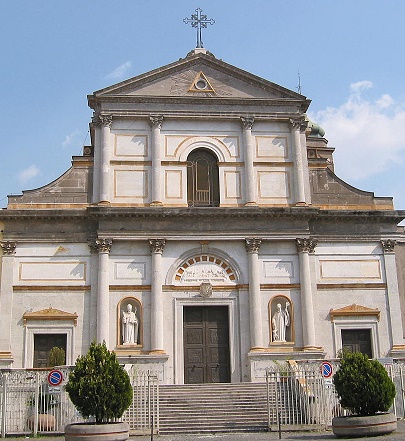
The Cathedral of Santa Maria Assunta of Avellino
The Cathedral of Santa Maria Assunta and San Modestino is the Cathedral of the Diocese of Avellino.
Located right in the heart of the Irpinia city, exactly in the highest point of the old part.
The Cathedral is considered the greatest place of worship for Avellino people.
The citizens who consider it a symbol and a point of reference.
Built between 1132 and 1166 at the behest of bishop Roberto. The Cathedral kept its original appearance until the end of ‘600, when it was restored in Baroque style and assumed many of the features that we find still today.
It was then the bishop Francesco Gallo to further fine-tune it in neoclassical style in the second half of ‘800. The building was severely damaged earlier by the bombings of the Second World War, and later by the crushing earthquake that devastated Irpinia in 1980.
It was then that the Cathedral experienced important interventions of consolidation and seismic retrofitting.
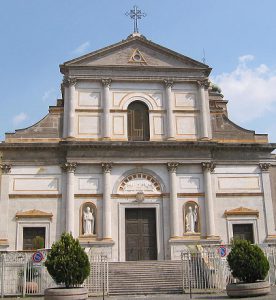 The facade has three bronze portals, two lateral and one central, depicting the highlights of the religious and civic life of Avellino.
Next to the main entrance you can admire two niches where there are the statues of San Modestino and San Guglielmo.
The Cathedral is accessed via a staircase, remained in Baroque style; on the right, however, we find the bell tower, whose lower part dates back even to Roman times.
Once inside, you immediately notice the Latin cross plan divided into three naves. In the lateral ones there are nine chapels, plus one – that served as Baptistery, ed – with a magnificent painting that represents “the Annunciation”.
In ten small domes of the aisles you can easily see some evangelical episodes from the life of Mary.
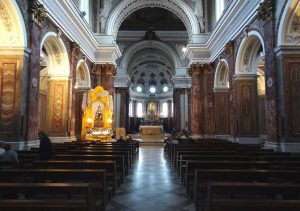 Also in the central nave there are works of great importance, such as the painting “Maria Assunta in Cielo” by Michele Ricciardi. Splendid the panelled ceiling, realized in ‘700.
From the aisles you reach the transept via a few steps, and from there directly to the altar and to two chapels that are located laterally to the presbytery: the chapel of San Modestino on the left (which houses the relics of the saints to whom the Cathedral is dedicated), the Chapel of the Holy Trinity on the right.
Always from the transept you come to the apse, with the sixteenth-century wooden choir in whose stalls are represented evangelical episodes of the Passion of Christ, and to the crypt in Romanesque style: also here you can admire some frescoes by Ricciardi, dating back to the eighteenth century.