
Le Castella
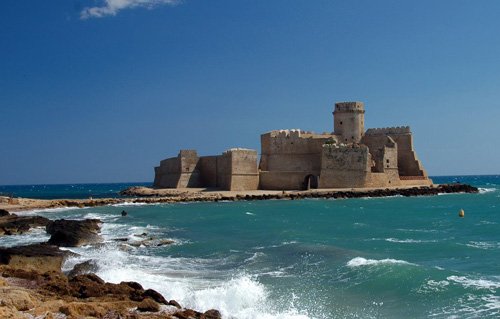
On the Ionian coast of Calabria there is Le Castella with its ancient Aragon fortress, in a hamlet of Capo Rizzuto Island, in the province of Crotone.
Background
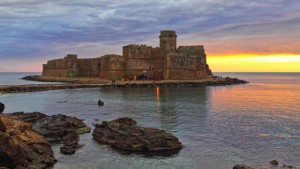 On Le Castella in the past there were many legends. But the historical origins probably date back to the Romans (though there were found remains of Greek masonry), it should be founded as a Roman colony.
There was a pact of war truce between Rome and Taranto, this stated that it should be founded a Roman colony of 3,000 settlers, called Castra.
In this way they could watch each other’s ships, the truce would have failed if one of the two cities dared to cross the border delimited within it was allowed to sail.
A legend says that exactly in this place, Hannibal managed to escape from the Romans during the Punic wars, taking refuge under some rocks.
From the period of the Dark Ages there aren’t a lot of data, but as regards instead the Middle Ages, it’s surely known that there was a population increase and economic wealth.
The old fort was built in the fifteenth century and it was mainly used to house the soldiers who were trying to repel the attacks coming from the sea by the invaders. In the years different population followed one another, as it can be seen from the different construction periods. The Normans, Swabians, Byzantines, Angevins and Aragons.
Furthermore there were Turkish and Ottoman invasions. It is in the Aragon period that the fortress acquired its present architectural structure.
In the period between the seventeenth century.
At the beginning of the twentieth century Le Castella was scarcely inhabited, while from the second half of the twentieth century to date there has been a re-population and economic growth mainly because of tourism.
And it is from 1991 that it has become part of the Marine Protected Area of Capo Rizzuto.
Places of interest and curiosities
Le Castella was also chosen as a film set for L’Armata Brancaleone and Il Vangelo secondo Matteo. In 1999 it hosted the thirtieth and last edition of It’s a Knockout.
Places of interest in addition to the aforementioned Fortress:
- Great Greek Caves
- Church of the Visitation of the Blessed Virgin Mary
- Walls of the village
- Franciscan monastery ruins
- Porta de Fora
- Two Harbors
- Several sculptures
- Coastal towers and sighting towers (Torre Brasolo, Torre Telegrafo, Torre Ritani)