
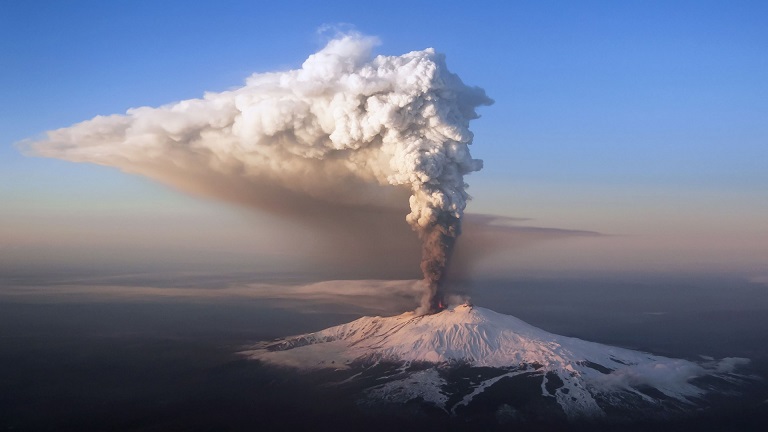
Mount Etna, an active volcano
When it comes to volcanoes or even only Sicily what comes to mind is the highest active volcano in Europe: Mount Etna.
Also called Mongibello, Etna is located halfway up the east coast of the island.
Appearance and history
Mount Etna is truly an awesome show to see, because of its majesty. It has a base diameter of 40 km, while the height is more than 3300 m.
The central crater has three mouths, and the structure in general is very complex.
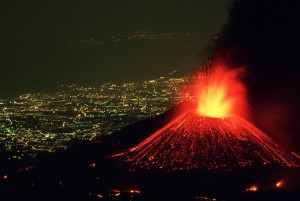 Among the numerous eruptions occurred from ancient times until now, the most catastrophic happened in 1669.
It originated at the Red Mountains (which were formed precisely with that eruption), then reached Catania on the west side, destroying its outer part coming up to the walls.
Before the eruption, there was a huge roar and an earthquake, a high amount of very fluid lava (and so very fast) came out of an enormous fissure that opened.
The lava came down to the sea, however, before it buried all what it found in its path, including villages.
The eruption lasted for 122 days, emitting millions of cubic meters of lava.
Other major eruptions were in 1928, that in 1950-51 which lasted for well 372 days, in 1971, 1985, 1986, 1987, 1992, 2002.
Observers and landscape
 To study the active volcano exist: the Etna Observatory, from Institute of Volcanology at the University of Catania; the Etna Station, or roadhouse; and the stellar branch of Astrophysical Observatory of Catania, which is equipped with a large 91 cm reflector.
The flora of the place is made of the wood of beech, pine and birch trees, the wood of oak and chestnut trees, and mountain pastures.
Then there are the areas where people live, but beyond a certain point there is no fixed habitation.
The soil is very fertile, being volcanic soils, there are cultivated quality products for which Sicily is famous: olives, citrus and grapes.
It not by chance is a major tourist destination, because of the beauty and characteristics of the place.
Sicily Region established the Etna Natural Park (1987), which joined the UNESCO world heritage