
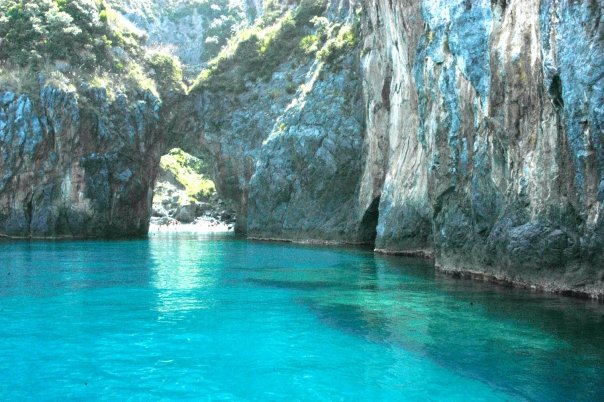
Arcomagno, the blue treasure of San Nicola Arcella
Welcome to Calabria. The northern part on the Alto Tirreno Cosentino.
San Nicola Arcella is, in fact, the third country on the coast past the small strip of the land of Basilicata.
The Arcomagno beach is one of the most enchanting surprises that this seemingly bare territory can reserve, especially if you look at the mountains of the Pollino and also at his steep, remaining breathless and losing perception among the cliffs, costantly overlooking onto a very blue sea.
The Arcomagno is located in the municipality of San Nicola Arcella, between Praia a Mare and Scalea.
It is a small jewel that has the village in the highest part at about 100 mt above sea level and beaches that kiss the low perimeter.
Slightly hidden among the cliffs that characterize the morphology of this stretch of coast, stands out a wonderful arch, which guards an actual blue treasure. A fresh and shady beach that almost seem to be the sirens’ home.
How to get to Arcomagno
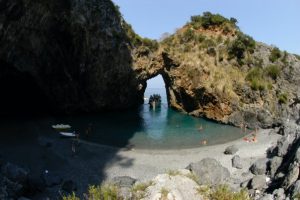 The Arcomagno beach is reachable both on foot and by the sea. In this latter case, just rent a pedal boat or give yourself a relaxing afternoon on a real boat.
If you choose to walk, it requires a little more effort, just because you have to leave the car in the adiacent parking lots (near the beaches of San Nicola Arcella).
Then, it is recommended to proceed through the ladder between the rocks that connects the Arcomagno to the main beach.
After that ladder, you will find a short dirt path on the cliff suitable for everyone. You will notice many families with children there.
It might be a slight effort, though. However, you are going to be rewarded once you get there: you will enjoy the absolute wonder of an almost untouched territory, in which the writer Lord Francis Marion Crawford had fallen in love many years ago, during his stays in the Tower of Crawford (which can also be admired from the beach of San Nicola Arcella).
Why is it called the Arcomagno beach?
Plain and simple: in its evolution, the cliff, probably crafted by the erosion of the sea, went through a “digging” work that made the arch grow, which consequently opened a gap that conduct straight to the beach.
What you will see will actually be a “flyover” on the sea.