
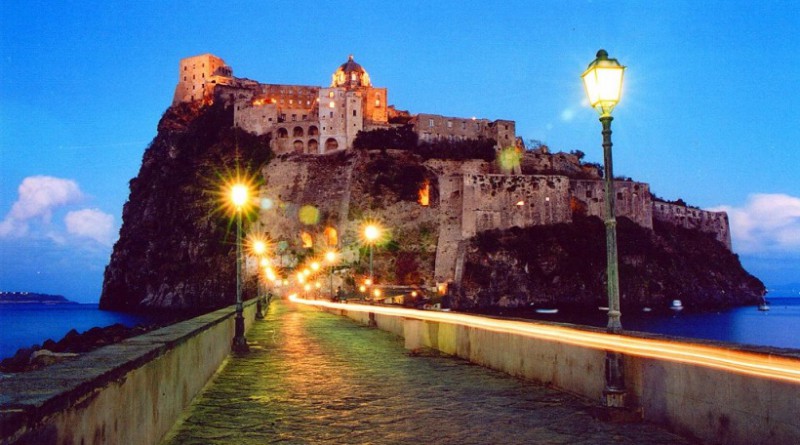
Aragonese Castle
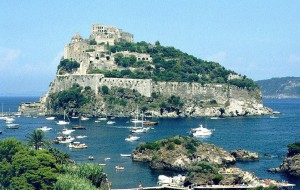
The island of Ischia is definitely one of the most beautiful landscape jewels of Italy and it is right there that on a tidal island of trachytic rock, on the eastern side stands the majestic Aragonese Castle.
This wonderful fortress is connected to the ancient village of Celsa through a bridge called Ischia Bridge.
The castle was built on an islet formed by a volcanic eruption occurred more than 300,000 years ago. It is at the height of 113 meters above sea level and the land is about 56 000 m².
Background of Aragonese Castle.
The first castle was built in 474 BC by the Syracuse Greek Gerone I, in fact the fortress was named in honor of his founder Castrum Gironis, ie “Gerone’s castle”. Gerone I went with his fleet to help the Cumans in the war against Tyrrhenians. Since the Cumans were owed to Gerone they buckled him the island.
The fortress was later occupied by Parthenopeans, before being conquered by Romans in 315 BC and the castle turned its function into a defensive fort.
So that tall towers were built to guard the enemy ships, furthermore they also built houses.
 In the following centuries the castle underwent many structural transformations due to continuous lootings and dominations of Visigoths, Vandals, Goths, Arabs, Normans (1134-1194), Swabians (1194-1265) and Angevins (1265-1282) .
When in 1301 there was the Arso eruption that destroyed the city of Geronda, the island’s inhabitants took refuge in the castle. In fact there they could rely on greater security. So it was that came to life a real haven where to live.
The present structure of the castle is due to the Aragons.
It was in fact Alfonso of Aragon who rebuilt it in 1441, the current form is: quadrangular with walls equipped with four towers.
He also connected the islet to the main island by a wooden bridge (now replaced by a stone bridge) and he built strong walls and fortifications within which the people of Ischia found refuge and protection from pirate raids.
At the end of the sixteenth century the castle was home not only for 1892 families, but also for the convent of the Poor Clares, the abbey of Basilian monks of Greece, the bishop with the chapter and the seminary, the prince with the garrison and well 13 churches including the Cathedral.
Then in the second half of the eighteenth century, since there was no longer the danger of pirates, people slowly left the castle to find most comfortable houses in Ischia.
It was almost completely destroyed by the British in 1809, while it was in the hands of the French. In 1823 the King of the Two Sicilies, Ferdinand I, sent off the 30 remaining inhabitants and transformed the castle into a place of punishment for the convicts, then in 1851 it became a political prison.
In 1912 the Aragonese castle was sold and today is open to the public.
Interesting sites.
- Church of the Immaculate
- Convent of the Poor Clares
- Cemetery of the Poor Clares
- Cathedral of the Assumption
- Crypt of the Cathedral
- Church of St. Peter in Pantaniello