
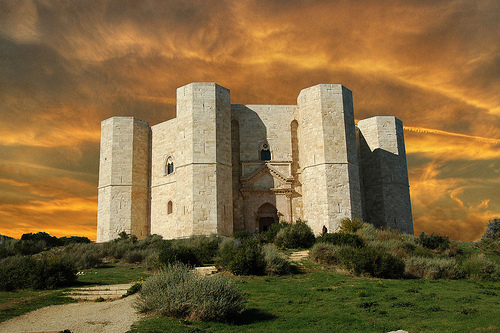
The mysterious Castel del Monte
When you talk about Castel del Monte the “magic number” is 8, yes because its structure revolves all around this number.
Not only its shape is octagonal, but also all the other parts of the structure, it is a castle studied in detail on the octagon.
The octagonal courtyard gathers eight halls (ground floor and first floor) and eight are the towers obviously octagonal too.
This charming castle is located in Puglia, in the town of Andria in the province of Barletta-Andria-Trani. In 1936 it joined the list of Italian national monuments, while in 1996 it was listed as a UNESCO World Heritage Site.
Background
Castel del Monte was built by Emperor Frederick II, in the thirteenth century. It is uncertain who was the architect, but it seems it was built on the ruins of a former fortress that was earlier Lombard and then Norman.
It is very likely that the castle was not finished yet when Frederick II died in 1250.
From the seventeenth century it began a period of neglect in which all the wall decorations of marble and the furniture were removed, furthermore the castle was used as a prison, a shelter for shepherds, bandits and political refugees.
Finally in 1876 Castel del Monte was bought by the Italian government, in 1879 the restoration works began. There were further restorations in 1928, and between 1975 and 1981.
In 1996 as already mentioned above it was listed as a World Heritage Site by UNESCO, precisely because of the symbolic significance Frederick II imbued it with, the mathematical and astronomical precision of the disposition and for its exactly regular shape.
But also because of the uniqueness of the architecture that is a harmonious ensemble of elements from classical antiquity, Islamic world and North European Cistercian Gothic.
A very special castle: hypotheses about its function
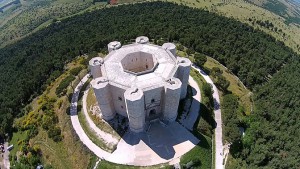 Castel del Monte is still nowadays a building full of mysteries, in fact its precise function is still unknown, here are some possibilities:
Although it is commonly defined as “Castle” it does not really present those elements that are typical of a veritable fortress, in fact it has no typically military elements such as moats and it’s not placed in a strategic position.
Other elements reveal that the idea of fortress is discarded.
For example: the spiral stairs in the towers are placed counterclockwise and in the case of enemy assault the soldiers would have to take up arms with the left hand; the embrasures are too tight.
The idea of a hunting lodge; there are however neither stables nor typical rooms that the hunting lodges have.
Because of the symbolism the castle is soaked with, it was thought to be a kind of temple, or temple of knowledge, where to dedicate to study of sciences.
It is also believed to be a kind of “path” perhaps tied to astronomical criteria.
An additional hypothesis is that of the “wellness centre” for the regeneration and care of the body, on the model of the Arabic hammam.
Finally, the shape which revolves around the octagon suggests that it was built to quote the shape of the crown. And so Castel del Monte would be essentially a monument of the imperial power of Frederick II.