
The National Archaeological Museum of Umbria
The National Archaeological Museum of Umbria is located in Perugia, in Giordano Bruno Square, and is housed within the premises of the old convent of San Domenico.
The oldest part is the church of San Domenico Vecchio, to which later were joined convent buildings.
The first ‘museum’ presence in town (exactly at the Palazzo dei Priori) can be traced back to 1790, when Francesco Filippo Friggeri, Perugian nobleman, donated his entire collection.
Later it was the work of the archaeologist Giovanni Battista Vermiglioli and his successors that contributed profoundly to the growth of the Museum.
It was in 1948 that the Civic Museums were moved to the current location.
Until 1958 the direction was entrusted to Umberto Calzoni, who further enriched the collection already expanded considerably with the prehistoric and proto-historic material derived from the work of Giuseppe Bellucci at the beginning of the century.
In 1960 the State took over the direction of the Museum.
The museum is divided into different rooms depending on the various thematic criteria, with texts and images that help the visitor in his path.
Among the major exhibitions, must be mentioned without a doubt the Etruscan-Roman and prehistoric collections formed from the nineteenth century.
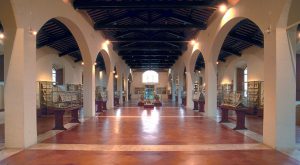 The core is characterized by material found in the excavations operated in the surroundings of Perugia, where there are many necropolis.
In particular, should be noted the sarcophagus of Sperandio and the exceptional complex of archaic bronzes from Castel San Mariano.
If you move to the upper floor, you can admire the pre-protohistoric materials of different areas of central Italy.
Many of these discoveries belong to the Bellucci collection.
If you instead go to the basement, you can enjoy the reconstruction of Cutu tomb, an underground tomb that houses a sarcophagus and 52 funerary urns, belonged to the men of “Cai Cutu” family.
Finally the Bronzes Room, which must be absolutely visited carefully.
In addition to the material of the splendid collections we were talking about previously, or rather those of Bellucci and Calzoni, recently the Room has been enriched by a new section.
This follows the latest museological criteria and in particular shows the dynamic development of Umbrian and Etruscan, civilizations located to the left and to the right of the river Tiber.